

One of the best things about living in Raleigh is something you have to leave Raleigh to enjoy. In three hours you can be standing somewhere above four thousand feet with the whole Blue Ridge turning gold in front of you, and be home for dinner the next day.
I grew up taking this drive. My family did it the same weekend every October, we always left later than we said we would, and we always hit traffic in Blowing Rock. I still go, and I still leave late.
Here is how to plan it properly: when the color actually peaks by elevation, which trip to pick depending on what you want out of the weekend, the specific overlooks worth pulling over for, and what to do if all you have is a Saturday.
One honest note before you book anything. N.C. State's foliage experts are calling for a patchier, more muted season in 2026 after a hot and dry summer. The Asheville area came through the drought best and has the most promise. It will still be a beautiful weekend. Just go with realistic expectations and you will have a better time.
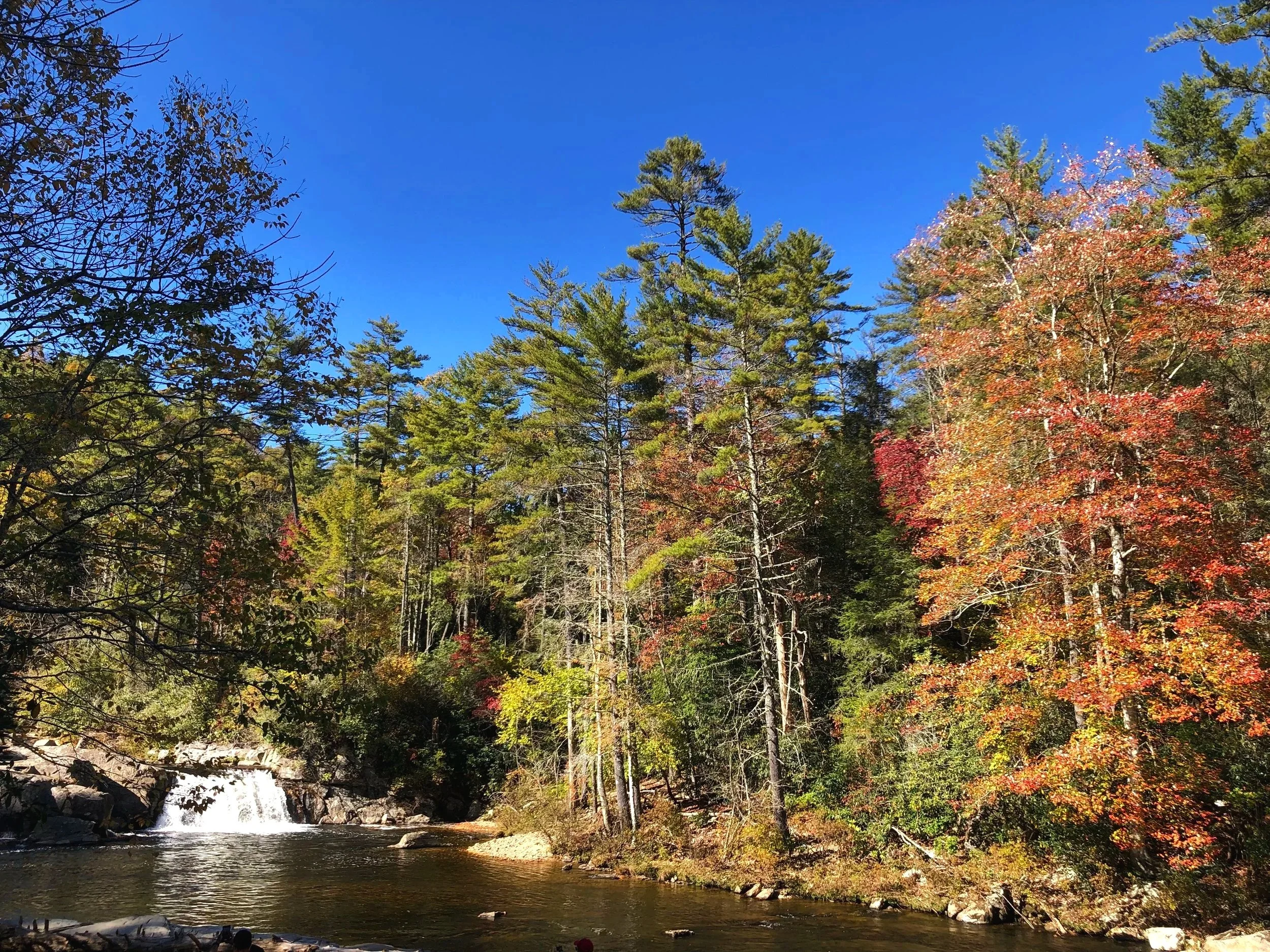
When the leaves actually turn
The single most useful thing to understand about leaf season in North Carolina is that it is not a date. It is an elevation, and it walks downhill over about six weeks.
Color starts on the highest peaks in late September and arrives in our own front yards in Raleigh in early November. If you know roughly what elevation you will be standing at, you can pick your weekend with real confidence. Here is how it moves.
Mid to late September, above 6,000 feet. The high peaks go first. Mount Mitchell and Richland Balsam start turning while it is still technically summer, and exposed ridges like Rough Ridge, Graveyard Fields, Waterrock Knob and Black Balsam show early color.
Early October, above 5,000 feet. Beech Mountain, Mount Pisgah and the Devil's Courthouse area come in.
The second week of October, 4,000 to 5,000 feet. Max Patch, Roan Mountain, Whiteside Mountain, the highest Smokies ridges and the Cherohala Skyway peak.
The third week of October, 3,000 to 4,000 feet. This is the week. Long stretches of the Blue Ridge Parkway peak all at once, along with Little Switzerland, Spruce Pine, Bakersville, Banner Elk, Linville Gorge including Table Rock and Hawksbill, and Pisgah National Forest near Brevard. If you can only take one weekend off, take this one.
The fourth week of October, 2,000 to 3,000 feet. Asheville itself peaks, along with the Biltmore grounds, the French Broad, DuPont State Forest, the N.C. Arboretum, Sylva and Saluda.
Early November, 1,000 to 2,000 feet. Color fills Hickory Nut Gorge at Chimney Rock and reflects off Lake Lure. Lake James and South Mountains close out the season. Back home in Raleigh, our own peak lands right about here.
The practical takeaway: the Parkway climbs from roughly 2,200 feet to over 6,000, so at any point in October there is peak color somewhere on it. You are not chasing a date. You are choosing an elevation.
Five trips worth taking from Raleigh
These are the five I actually recommend, with honest drive times from the Beltline and what each weekend is genuinely best for.
Blowing Rock and Boone, about 3 hours
The classic, and the right answer for a first trip. Blowing Rock is a walkable little downtown with good shops and better food, and you are minutes from Grandfather Mountain and its Mile High Swinging Bridge, Moses Cone Manor with its carriage trails, and Julian Price Park. Bring kids and you add Tweetsie Railroad.
Peak here is generally the third week of October. It is also the most crowded place in the mountains that week, so book your room now and accept that you will sit in traffic on Main Street.
Asheville, about 3 hours 45 minutes
The grown-up weekend. Asheville peaks in the fourth week of October, later than most people assume, and this year it is the part of the mountains that came through the summer in the best shape. Biltmore's grounds are worth the ticket in late October specifically. The food and the breweries are the real reason to go, and the color is the excuse.
Best for couples, for a weekend where you want to sleep in, and for anyone who would rather walk a city than a trail.
Linville Gorge and Grandfather, about 3 hours 15 minutes
The hiker's version. Linville Falls, Table Rock and Hawksbill Mountain give you the most dramatic terrain in the state, and the Linn Cove Viaduct curling around Grandfather is the single most photographed stretch of the Blue Ridge Parkway for good reason.
This one requires real shoes and real planning. Some of these trailheads have small lots that fill by eight in the morning on an October Saturday.
Chimney Rock and Lake Lure, about 3 hours 30 minutes
The late bloomer, and the one I send people to in early November when they think they missed it. Hickory Nut Gorge holds color into the first week of the month. Chimney Rock State Park gives you a 75-mile view for a very short walk from the elevator, which makes it the best effort-to-payoff ratio in the mountains, and Lake Lure below it doubles the color on the water.
Brevard and DuPont State Forest, about 4 hours
For waterfalls with your leaves. Looking Glass Falls is right off the road, and DuPont's Triple Falls and Hooker Falls are an easy loop. Pisgah National Forest around Brevard peaks in the third week of October, DuPont in the fourth.
A practical note for all five: sections of the Blue Ridge Parkway still close for weather and repair work, sometimes on short notice. Check the official road closure map the morning you leave, not the week before.
The Parkway stops worth pulling over for
The Blue Ridge Parkway has hundreds of overlooks and you cannot stop at all of them, though your passengers will suggest it. These are the ones I would not skip, listed by milepost from north to south so you can plan a day's driving.
Milepost 294, Moses H. Cone Memorial Park. Carriage trails through open meadow, easy walking, and the manor house at the top. The most relaxed stop on this list.
Milepost 302.8, Rough Ridge. A boardwalk climb to the view everyone has seen on a postcard, looking down at the Linn Cove Viaduct. Small parking lot, go early.
Milepost 304.4, Linn Cove Viaduct. The bridge that curls around Grandfather Mountain. Stop at the visitor center and walk underneath it for the better photograph.
Milepost 316.4, Linville Falls. Several overlooks off one trail system, from a fifteen-minute walk to a real hike. The gorge below turns dramatically.
Milepost 355, Mount Mitchell. The highest point east of the Mississippi at 6,684 feet. Turns color first and coldest, and there is often a twenty-degree difference from the valley. Bring the jacket you think you will not need.
Milepost 364.6, Craggy Gardens. Above the treeline, with a short trail to a bald and a very big view. One of the best stops on the whole road.
Milepost 418.8, Graveyard Fields. Open high country with two waterfalls and a loop trail. The lot fills absurdly early in October.
Milepost 422.4, Devil's Courthouse. A steep quarter mile to a rock outcrop where you can see four states on a clear day.
Milepost 431, Richland Balsam. The highest point on the Parkway itself at 6,047 feet, and one of the first places to turn.
Milepost 451.2, Waterrock Knob. Sunset. That is the whole recommendation. Get there for sunset.
Driving the Parkway is slow by design. The limit is 45 and in practice you will average well under it with the stops. Budget about twice the time your map app tells you, and do not plan to drive it after dark. There are no lights and plenty of deer.
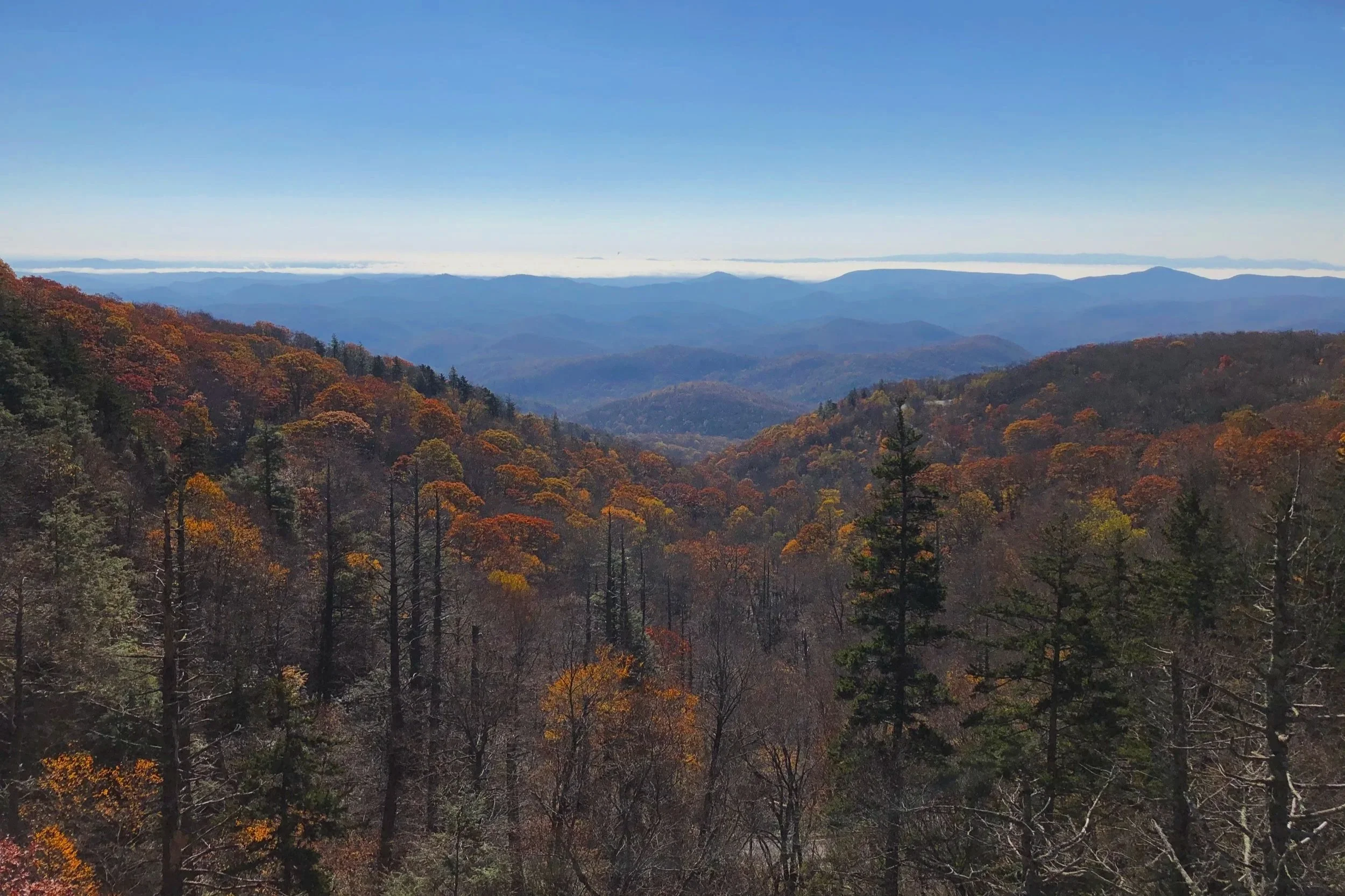
If all you have is a Saturday
Not every fall gives you a free weekend, and a four-hour drive each way is not a day trip. These are close enough to leave after breakfast and be home for dinner. All of them peak late October into early November rather than mid-October, so they buy you extra time.
Hanging Rock State Park, Danbury, about 2 hours. The best return on a two-hour drive in the state. Real elevation, five waterfalls, and a summit trail that is genuinely worth it without being punishing.
Pilot Mountain State Park, about 2 hours. You can drive most of the way up. The view from the pinnacle over the rolling color below is the payoff, and you barely have to earn it.
Stone Mountain State Park, about 2 hours 30 minutes. A 600-foot granite dome with a waterfall loop. Quieter than the other two on a peak weekend.
Raven Rock State Park, Lillington, about 1 hour. The closest thing to a hike with a view that you can reach in an hour from Raleigh. The bluff over the Cape Fear is better than you expect.
Eno River State Park, Durham, about 40 minutes. River bottom hardwoods, and some of the prettiest close-in color anywhere in the Triangle.
Occoneechee Mountain, Hillsborough, about 50 minutes. The highest point in Orange County, a short loop, and an overlook that feels like it should be much further from home. Pair it with lunch in downtown Hillsborough and you have a full and very easy day.
Sarah P. Duke Gardens, Durham, about 35 minutes. Not a hike at all. Fifty-five acres of designed landscape that peaks beautifully in early November, and it is free.
If you have a half day rather than a full one, Eno River and Occoneechee are the two to pick.
How to actually pull this off
The difference between a great leaf weekend and a frustrating one is almost entirely logistics.
Book now, not in October. Rooms in Blowing Rock, Boone and Asheville sell out for the peak weekends months in advance, and what is left roughly doubles in price. If you are reading this in September and thinking about the third weekend in October, book today.
Leave Friday night if you can. The Saturday morning drive out of Raleigh puts you into the mountains at exactly the same time as everyone else. Getting in Friday evening and waking up there is worth the extra night.
Check color the week you go, not the month before. RomanticAsheville's week-by-week guide is the most reliable running report, and the state forecast from N.C. State gives you the season-long picture. Check the Tuesday before you leave and be willing to move up or down a thousand feet.
Fill the tank before you get on the Parkway. There are no gas stations on it. None. Plan your fuel around the towns.
Download your maps offline. Cell service on the Parkway ranges from spotty to nonexistent, and the one time you need directions is the time you will not have a signal.
Dress for a different climate. It can be twenty degrees colder at 6,000 feet than it was in the parking lot in Asheville, and windier than you are picturing. Layers, a real jacket, and shoes with tread.
Go early or go Sunday. Trailhead lots at Rough Ridge, Graveyard Fields and Craggy Gardens are full by eight or nine on an October Saturday. Sunday morning is noticeably calmer than Saturday afternoon.
And give yourself permission to pull over. The whole point is the drive. If you are watching the clock, you picked the wrong weekend.
Leaf season questions we get asked
When is peak fall color in the North Carolina mountains in 2026? Peak moves downhill by elevation. Above 6,000 feet it starts in late September. The 4,000 to 5,000 foot range peaks around the second week of October, 3,000 to 4,000 feet the third week, and Asheville itself the fourth week. Early November brings peak to Chimney Rock and Lake Lure.
What is the single best weekend to go? The third weekend in October. That is when the longest stretches of the Blue Ridge Parkway peak at once. It is also the busiest, so book early.
How far is Asheville from Raleigh? About 3 hours and 45 minutes. Blowing Rock and Boone are about 3 hours, Grandfather Mountain and Linville Gorge about 3 hours 15 minutes, and Chimney Rock about 3 hours 30 minutes.
Can you do the mountains as a day trip from Raleigh? You can, but I would not. Seven to eight hours of driving for a few hours of daylight is a long day. If you only have one day, go to Hanging Rock or Pilot Mountain instead, both about two hours out.
Where is the best view on the Blue Ridge Parkway? Rough Ridge at milepost 302.8 for the classic photograph, Craggy Gardens at 364.6 for the biggest open view, and Waterrock Knob at 451.2 for sunset.
Where can I see fall color near Raleigh without driving to the mountains? Eno River State Park and Occoneechee Mountain are under an hour. Hanging Rock, Pilot Mountain and Raven Rock are one to two hours. In the city itself, Historic Oakwood, Lake Johnson and Umstead State Park all turn in late October and early November.
When do the leaves change in Raleigh? Late October into early November, two to three weeks behind the mountains.
Is the Blue Ridge Parkway fully open? Sections close for weather and repairs, sometimes without much warning. Check the National Park Service road closure map the day you leave.
Will 2026 be a good color year? It is forecast to be patchier and more muted than average because of summer heat and drought, with the Asheville area in the best shape. Still worth the trip, just temper expectations.
One last thing
The reason I keep making this drive is not really the leaves. It is that three hours from my front door there is a place that looks nothing like where I live, and I get to have both.
That is a genuinely underrated part of being in Raleigh. Mountains in three hours, the coast in two, and a city worth coming home to in between. When clients ask me what it is actually like to live here, this is usually the part that lands.
If you are thinking about making the Triangle home, our team would love to show you around, in October or any other month. And if you are staying put this fall and want the local version of this list, we put together a full guide to fall in Raleigh with the farms, festivals and State Fair dates.
Drive times, dates and conditions change. Everything here was checked in September 2026. Confirm Parkway closures before you leave.
